Spain hikes VAT on tourist apartments to 21%, airports change model and Visa enters travel
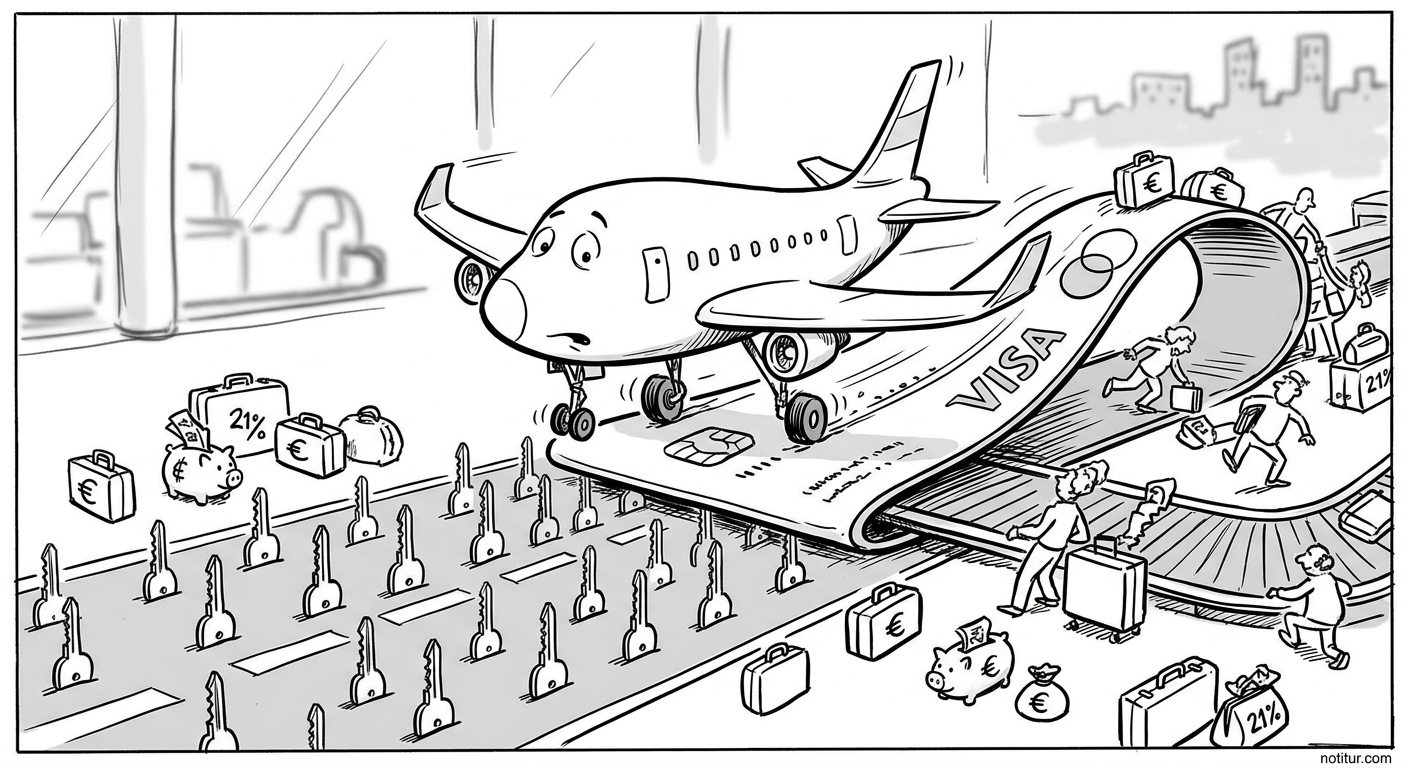
The travel market faces a week of structural readjustments: the Spanish government takes the VAT hike on tourist apartments to 21% to Congress, European airports admit their traditional business model is broken, and Visa enters travel as a direct competitor to its own card issuers. Meanwhile, the peak European summer booking season is in full swing and the Independence Day holiday in the US is just four days away, meaning hotel and airline demand is at maximum tension. As we previewed yesterday in our analysis of ITH launches campaign to make real hotel innovation visible in 2026, the industry is scrambling for efficiency levers in an increasingly margin-squeezed environment.
Today's brief
The accommodation war heats up: the government equalizes VAT on tourist apartments with hotels, and hotel distribution discovers its best channel is not its most profitable.
- The Spanish Council of Ministers has agreed to take to Congress in July a hike in VAT on tourist apartments from 10% to 21%, aligning them fiscally with hotels. Minister Elma Saiz calls it an "ambitious and cross-cutting text" Hosteltur. The impact on short-term rental supply will be immediate: thousands of properties will become unprofitable, especially in urban destinations where the market was already strained.
- At the same time, an analysis by DemandCalendar reveals that hotels measuring only by revenue volume make blind decisions. Gross Operating Profit per channel shows that the highest-grossing channels (Booking, Expedia) typically yield the lowest net margins. The takeaway: the "best channel" doesn't exist if you're not looking at GOP 10 Minutes News for Hoteliers.
 notitur.com
Hotels
Real profitability is the new mantra: hotels redesign their channel mix while short-term supply gets hit with the 21% VAT.
The VAT hike to 21% on tourist apartments doesn't just affect owners, hotels could see a demand shift if legal vacation rental supply contracts. But watch out: many of those properties will move into the gray market, making guest acquisition harder. The measure, part of a "grand housing agreement," could be operational in months if passed Hosteltur.
Meanwhile, the Hotel Tester survey by Eurostars Hotel Company, with nearly 200 guest proposals, confirms that summer guests want complete experiences: live music, rooftop yoga, themed dining and local community connection. A room is no longer enough. Rooftops are solidifying as hubs for activity and wellness 10minhotel.
Airlines and travel
European airports admit their business model is exhausted and seek alternatives, Iberia and Vueling test biomimetic efficiency.
ACI Europe has issued a serious warning: the current airport system, based on passenger volume growth, is no longer "reliable or sufficient." The next major investment phase requires a shift from a traffic-based model to one focused on value per passenger Nexotur. This implies more dynamic fees, modular services and likely higher costs for low-cost carriers operating on thin margins.
Iberia and Vueling, both in the IAG group, have announced they will begin applying "shark skin" technology to their fleet, developed by Australian company Mako. This coating reduces aerodynamic friction and can generate fuel savings of 1% to 3% per flight. At peak summer demand, any operational efficiency gain directly impacts margins Preferente.
Distribution and revenue
Visa enters travel as a direct competitor to its own clients, and hotel distribution learns to measure real channel profitability.
Visa has officially launched a consumer travel website, stepping directly into OTA territory and, more importantly, competing with the banks that issue its cards. The move is structural: Visa establishes a direct relationship with the traveler, disintermediating its own issuers Skift. For hotels, this opens a new distribution channel with a massive financial partner, but also adds competitive pressure on traditional OTAs.
Meanwhile, the Tourism Data Space (LINX) promoted by the Ministry of Industry and Tourism is now operational. Companies, destinations and universities can share and exchange tourism information securely. The goal: move from fragmented data to shared market intelligence that improves destination decision-making Smart Travel News. This move lays the groundwork for real-time data-driven distribution, something that will change how destinations are marketed in five years.
AI in travel
AI applied to hotel conversion achieves 90% accuracy in identifying potential bookings, and AI-native distribution is shaping up as the new battleground.
Roiback has unveiled its new integrated AI layer in its hotel distribution platform. Its OdysseIA system can identify up to 90% of potential bookings currently lost due to lack of personalization. It also optimizes ad campaigns and multiplies ROI by up to 3 times Smart Travel News (Roiback). This is not a pilot: it is already in production in real hotels. It confirms that AI applied to revenue and distribution is not the future, it is the present of peak season.
An analysis by Hospitality.today argues that Google will never build AI-native distribution. The search giant is designed to charge for the click, not to complete the booking. The GDS, with 40 years of structured data infrastructure, is the fertile ground where AI assistants can operate without friction Hospitality.today. This leaves the door open for startups and OTAs that integrate AI into the complete booking process.
What we are watching
- Independence Day (July 4): peak domestic travel in the US. Hotels capturing American outbound market must have dynamic pricing dialed in. This Thursday determines the week's ADR.
- VAT 21% on tourist apartments in Congress: debated in July. Vacation rental associations already threaten legal action. Regulatory volatility can freeze short-term rental investments.
- Skift Global Forum (Sept 16-17): less than 3 months away in New York. Visa's travel entry and new distribution models will likely be hot topics.
- LINX Data Space: the first real use case at a destination could be announced in the coming weeks. If it works, it will change the relationship between OTAs and destinations.
The government hiking VAT on tourist apartments to 21% is a move traditional hoteliers will applaud, but don't be fooled: supply won't disappear, it will go opaque. And while airports admit their model is broken and Visa enters the game, hotel distribution discovers its best channel isn't the most profitable. In the middle of July's booking frenzy, those measuring by GOP rather than topline will make decisions their competitors will pay for in winter.
Quick questions
How does the 21% VAT hike on tourist apartments affect hotels?
Why shouldn't hotels measure only by gross revenue per channel?
What new model are European airports adopting?
Startups
The travel startups we follow, plus the ones surfacing in today's news.
- In today's news
- FutureTravel SummitEvento anual de travel tech en Barcelona que reúne a fundadores, inversores y ejecutivos para definir el futuro del sector.
- ConduitPlataforma de agentes de IA para hospitality que automatiza mensajeria con huespedes ventas y operaciones en miles de propiedades
- StardriftPlanificador de viajes con IA que encuentra y reserva vuelos hoteles y actividades en una sola conversacion
Was this article useful?
The daily brief
Notitur in your inbox
One sharp travel-industry brief a day. Free.
Editorial content by Notitur. It may contain errors. Verify anything important with the original source.
This article may mention third-party products, companies or services for informational purposes. Notitur does not endorse them and is not responsible for them or for what they offer. Editorial content curated by the Notitur team.