AI Forces Mews to Rethink Its PMS
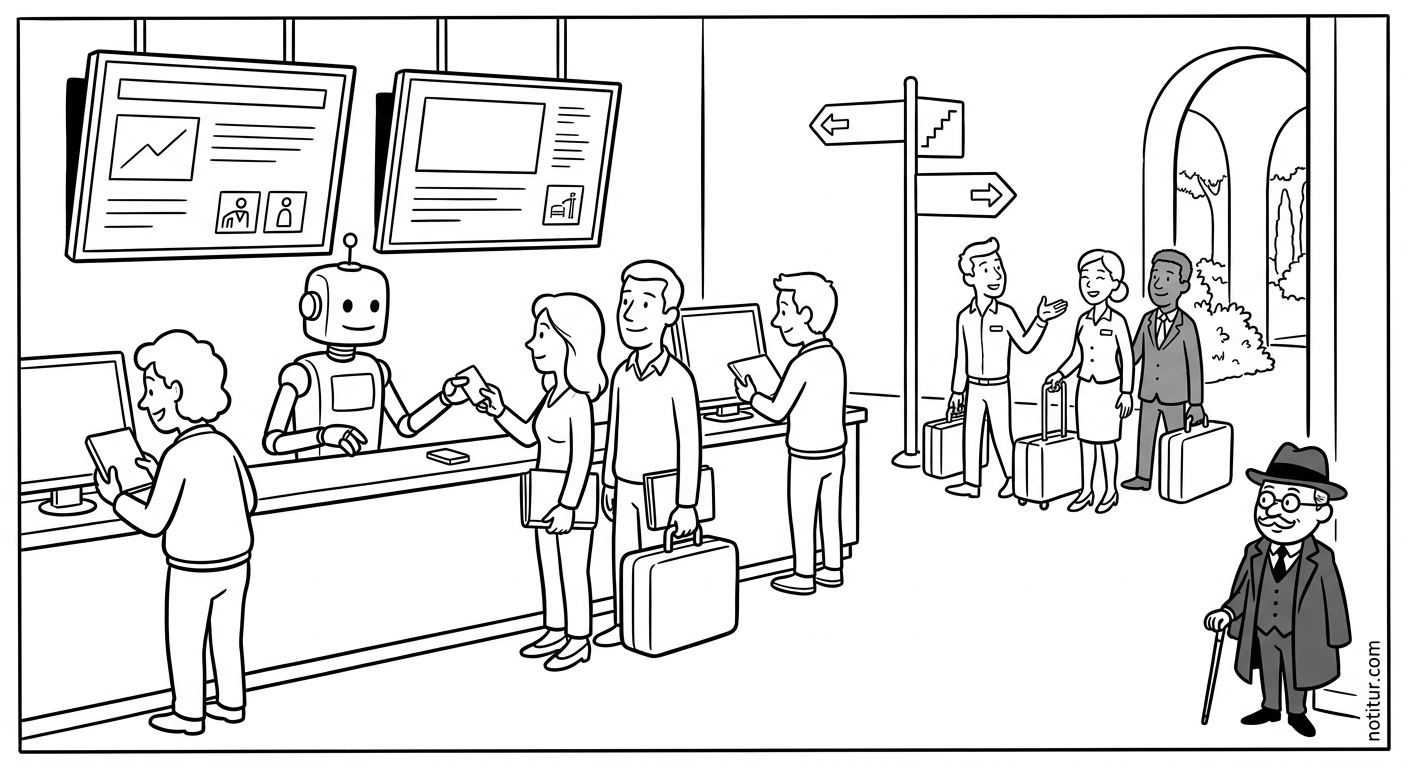
If you thought the AI wave in travel tech only touched customer service chatbots, Mews just gave you a cold shower. The company has announced layoffs of 15% of its workforce (about 200 people) in what founder and CEO Richard Valtr describes as a restructuring directly driven by artificial intelligence. According to statements reported by Skift, the decision is not about individual performance, but because certain roles "built for an era that is ceasing to exist" no longer make sense when a single person, supported by AI, can handle the work from start to finish.
Invisible hands no longer needed
For years, Mews operated with fragmented teams: design handed off to product, product to engineering, engineering to QA. Those handoffs slowed development and multiplied costs. Valtr says AI now enables a unified team to take over the entire flow, automating even tasks like bug fixing. The company has been pushing AI adoption and training staff in these tools for at least six months. The result: a flatter, faster, and above all, cheaper organization.
 notitur.com
From selling software to being a service provider
But the really interesting part is not just the headcount adjustment. It is the strategic pivot it reveals: Mews wants to move from being a software provider to a service provider. The thesis is that if AI absorbs part of the hotel's operational work (reservation management, check-ins, basic issue resolution), the platform can take on more functions that were previously beyond its scope. This would allow building deeper relationships with hoteliers through fewer but higher-value touchpoints. It sounds nice, but the million-dollar question is whether a smaller team can maintain support for more than 15,000 hotels without quality suffering.
A dance that is not unique
Mews is not dancing alone. Expedia, Amex GBT, and Oracle have made similar moves, cutting headcount while betting on leaner, AI-intensive operating models. The difference is that Mews, while cutting, is still expanding through 14 acquisitions, a partnership with SiteMinder, and a Series D round of 300 million dollars partly aimed at agentic AI. In other words, it is cutting to fund its transformation, not just to survive.
Conclusion: What is coming is not a PMS, it is a hotel operating system
The hotel industry has long complained that traditional PMS systems are rigid, expensive, and hard to integrate. The promise of a system that adapts on its own, automates processes, and frees hotel staff to focus on the guest is attractive. But the risk that the machine becomes impersonal is real. The question is not whether AI can do the work of 200 people. The question is whether it can do it with the same care as a human when a guest arrives at 3 a.m. with a wrong reservation. That will be Mews' real test.
Quick questions
Why is Mews laying off 15% of its workforce?
Exactly how many employees is Mews losing?
Which departments are the layoffs from?
How will this affect Mews' hotel clients?
Is Mews the only travel-tech company doing this?
Startups
The travel startups we follow, plus the ones surfacing in today's news.
Was this article useful?
The daily brief
Notitur in your inbox
One sharp travel-industry brief a day. Free.
Editorial content by Notitur. It may contain errors. Verify anything important with the original source.
This article may mention third-party products, companies or services for informational purposes. Notitur does not endorse them and is not responsible for them or for what they offer. Editorial content curated by the Notitur team.