Easyjet rejects $5.5B, agentic AI lands in 2026, Venezuela closes skies
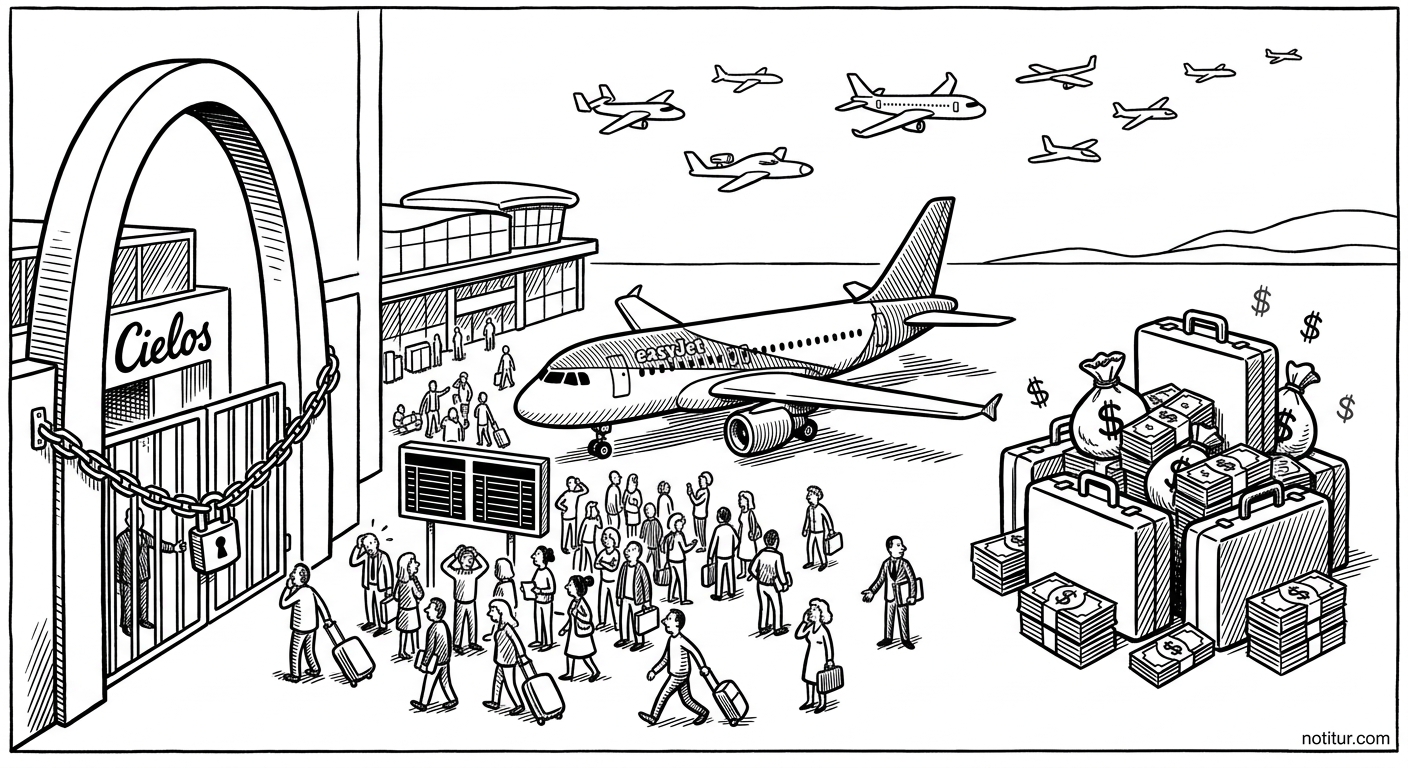
The travel industry faces three simultaneous fronts that reflect deeper tensions. A budget airline rejects billions in acquisition offers, signaling that consolidation for consolidation's sake is not strategy. Meanwhile, agentic AI promises to fragment demand further over the next decade, demanding radically more sophisticated technology infrastructure. And in parallel, a natural disaster in Venezuela suspends key Madrid-Caracas routes and puts into context how the sector must react in crisis. Three narratives of lost control: market, technology, and nature.
Today's brief
Easyjet still won't sell at €5.5 billion. Castlelake made its fourth offer for the British orange airline, improving on three previous bids with £4.93 billion (roughly €5.5 billion), approaching what was speculated the Easyjet board would accept. The board rejected it anyway. The message is crystal clear: even sufficient cash won't convince if strategic vision isn't credible. This breaks the narrative that any budget carrier is "for sale." Easyjet prefers operational independence over absorption by a fund that could dismantle its model. Details on Preferente.
Consolidation by decree doesn't work. Castlelake had been negotiating for months with steadily rising valuations. The rejection underscores that Easyjet minority shareholders see value in the brand and operations that other buyers fail to recognize. In a margin-compressed context, rejecting billions suggests Easyjet believes it can value itself higher as an independent player, or simply that this type of acquisition is no longer the natural path to airline distribution growth.
Earthquakes in Venezuela close Madrid-Caracas route across the industry. Iberia, Air Europa, and Plus Ultra suspended flights to Caracas after earthquakes measuring 7.2 and 7.5 magnitude severely damaged Maiquetía international airport. The Madrid-Venezuela route carries meaningful Spanish-speaking traffic and remittances, but infrastructure damage forced operational suspension. Meliá, operating a hotel in Caracas, made its property available to authorities for emergency health and humanitarian needs. Crisis and cross-business reputation management converge: when nature suspends your business, corporate response is worth more than the margin you lose.
AI and market intelligence
The decade 2026-2036 will be governed by agentic AI, not humans. A PhocusWire and RateHawk report identifies ten trends transforming travel distribution through 2036, with agentic AI at the epicenter. But it's not today's AI: autonomous agents that negotiate, decide, and book without human intervention. This will fragment demand into microniches, each served by different algorithms. It terrifies agencies and operators, but it's the reality already here.
Alongside agentic AI, the report adds demand fragmentation, social media influence, extreme price sensitivity, and more robust technology infrastructure as inescapable imperatives. The industry must understand this is not a problem of adding a feature to a booking engine, but of completely rearchitecting how travel gets distributed. Full analysis on Smart Travel News.
We're in peak European summer demand, as we noted when Spain logged record cruise numbers at 14M and agencies booked +5%, and now fragmentation predicts that demand will be captured across increasingly dispersed channels. An agency in Madrid that ten years ago had three clients for one route now has thirty, each seeking different pricing and experience. Without AI that centralizes price and experience intelligence, you'll be invisible.
Gaiarooms rises as hotel digital reference
Gaiarooms won the Best Digital Strategy in Hotels award at TH Awards 2026. The firm was recognized on June 18 in Madrid for its strategic approach to digital transformation in properties. Enrique Domínguez, Gaiarooms CEO, collected the award delivered by Clara Luz Onraíta of Hotelverse. Details on TecnoHotel.
The award in context: while the sector debates agentic AI, most hoteliers are still in "digital strategy" infancy. Gaiarooms leads, but the majority lack clear roadmap. This will be critical when AI agents start choosing which hotel to book based on system integration. A hotel without clear digital strategy will be invisible even to machines.
Demand: Japan hikes visa cost for Chinese by 500%
Japan raised visa costs by 500% for Chinese citizens, a drastic measure but one reflecting reality: Chinese tourist flow to Japan collapses due to restrictions China itself imposes on outbound travel. Japan, heavily dependent on Chinese tourism, chose to rely on tourism from other markets. Details on Preferente.
Visa pricing is a blunt but effective instrument: if China throttles passport issuance and outbound travel, Japan simply raises entry cost. Not xenophobia, it's economics: higher price, less Chinese demand, more demand from markets that can travel. This redraws tourism distribution maps across Asia for years ahead.
What we are watching
- Castlelake and Easyjet continue negotiating. The rejection is tactical, not final. Within weeks there will be a fifth offer, and the market will watch whether Easyjet finally yields or finds another capital strategy.
- Reopening of Maiquetía airport. Venezuela is Spain's gateway to Latin America. Repair timeline determines whether Iberia and Air Europa recover operations in Q3 or lose meaningful pax to competition.
- Skift Global Forum in New York in September. Nine weeks out, the industry will converge to debate exactly agentic AI and demand fragmentation. Today's sessions will map technology investment roadmap for H2 2026.
- Asian demand after Japan. If Japan softens visa for Chinese or China relaxes outbound travel restrictions, price movement will reset across the region. This impacts dynamic pricing across Asia.
Closing view
Today we see that consolidation by money volume no longer buys market share, that agentic AI is inevitable and requires complete distribution reengineering (not a patch), and that geopolitical and natural crises suspend businesses without warning. The sector that thrives will be one that understands these aren't three crises, but one: the fragmentation of power between machines, geography, and cash. Easyjet rejects Castlelake because it knows value lies in staying agile. Gaiarooms wins through complete strategy. Venezuela teaches that infrastructure fails. Japan raises prices because it can. The lesson is the same for all: adapt or disappear, fast.
Quick questions
Why did Easyjet reject a $5.5B offer?
What happened to Madrid-Caracas flights?
What is agentic AI and how will it impact travel?
Was this article useful?
The daily brief
Notitur in your inbox
One sharp travel-industry brief a day. Free.
Editorial content by Notitur. It may contain errors. Verify anything important with the original source.
This article may mention third-party products, companies or services for informational purposes. Notitur does not endorse them and is not responsible for them or for what they offer. Editorial content curated by the Notitur team.